

White Buffalo Turquoise vs. Howlite: What’s the Difference?
When most people think of turquoise, beautiful shades of blue and green come to mind. But what about those striking white stones with black or gray veining that are often sold as White Buffalo Turquoise or White Turquoise?
Despite their names, these stones aren’t necessarily turquoise at all.
Over the years, I’ve come across quite a bit of confusing information about White Buffalo, Howlite, and other similar-looking stones. Even among gemstone dealers, the names are sometimes used interchangeably.
As a rockhound and jewelry designer, I wanted to understand what makes these stones different. Here’s what I’ve learned through research and my own experiences collecting, cutting, and polishing them.
The History of White Buffalo Stone
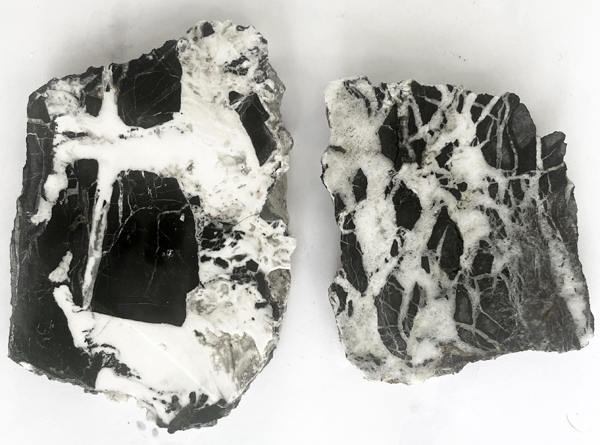 White Buffalo stone became widely known in the early 1990s through the Otteson family, longtime turquoise miners in Nevada.
According to Rock & Gem magazine, the Ottesons discovered the material in 1993. Its striking white coloring and contrasting black matrix quickly attracted attention, particularly among Southwestern jewelry artists and collectors.
Although the stone became known as White Buffalo Turquoise, it was eventually recognized that the material was not actually turquoise.
The name White Buffalo has remained popular, and today the stone is appreciated for its beautiful black-and-white patterns.
Is White Buffalo Really Turquoise?
The short answer is no.
Genuine turquoise gets its familiar blue and green colors from its mineral composition. White Buffalo, despite its name, is a different type of stone.
Mineral testing of some material sold as White Buffalo has identified minerals such as Magnesite and Dolomite. However, White Buffalo is a trade name rather than a specific mineral, so not every stone sold under that name necessarily has the same composition.
What makes White Buffalo especially attractive is the contrast between its white background and dark matrix. Some pieces have bold black patches, while others display delicate spiderweb patterns or soft gray veining.
And that’s part of the appeal. No two stones look exactly alike.
Discovering White Buffalo in Nevada’s Candelaria Hills
One of my favorite places to explore is Nevada’s historic Candelaria Hills mining district.
I’ve personally collected beautiful black-and-white stone known as White Buffalo in this area, and I’m continually amazed by the variety of patterns found in the rough material.
Some pieces have dramatic black-and-white contrasts, while others reveal softer gray markings, intricate veining, or unusual patterns that don’t become apparent until the stone is cut.
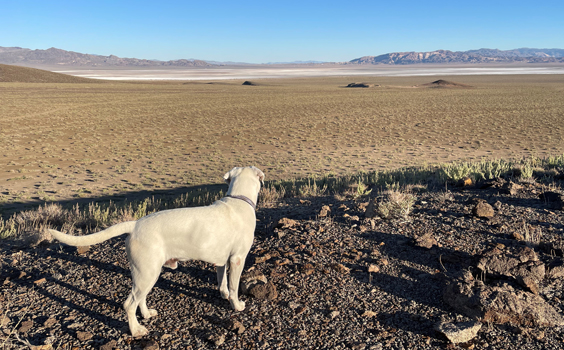
From my own rockhounding experiences, I believe there are multiple occurrences of this material throughout the Candelaria Hills.
There’s something especially rewarding about taking a weathered stone from the desert, cutting it open, and discovering the beauty hidden inside.
Although I know exactly where my stones were collected, I don’t claim to know their precise mineral composition without laboratory testing. I identify them by the trade name White Buffalo, which is how this type of material is commonly known in the lapidary world.
What About Midnight Buffalo?
Another interesting stone associated with the Candelaria Hills is Midnight Buffalo.
Unlike traditional White Buffalo, which is generally white with black matrix, Midnight Buffalo has a predominantly black background with white spiderweb patterns.
According to lapidary artist Russ Kaniuth in Rock & Gem magazine, Midnight Buffalo was discovered near Rodney Frisby’s Vista Grande Variscite mine in the Candelaria region.
It’s another example of the unusual variety of decorative stones found in this part of Nevada.
What Is Howlite?
 Howlite is a naturally occurring white mineral, often featuring beautiful gray, brown, or dark veining.
It can look remarkably similar to White Buffalo, especially after being cut and polished.
Howlite is also frequently dyed blue or green to imitate turquoise, which has contributed to some of the confusion surrounding these stones.
Personally, I think natural Howlite is beautiful just as it is. Its soft white coloring and delicate veining make it especially attractive in sterling silver jewelry.
Several years ago, I acquired some beautiful natural Howlite from a fellow lapidary enthusiast. The stone had wonderful gray and brown markings that reminded me of the patterns found on wild horses.
That inspiration led me to name my collection White Horse Jewelry.
White Buffalo vs. Howlite: What’s the Difference?
Although White Buffalo and Howlite can look very similar, they aren’t necessarily the same material.
Howlite is a specific mineral with its own identifiable composition. White Buffalo, on the other hand, is a trade name used for certain black-and-white decorative stones.
Some White Buffalo material has been identified as containing Magnesite or Dolomite, both of which differ from Howlite.
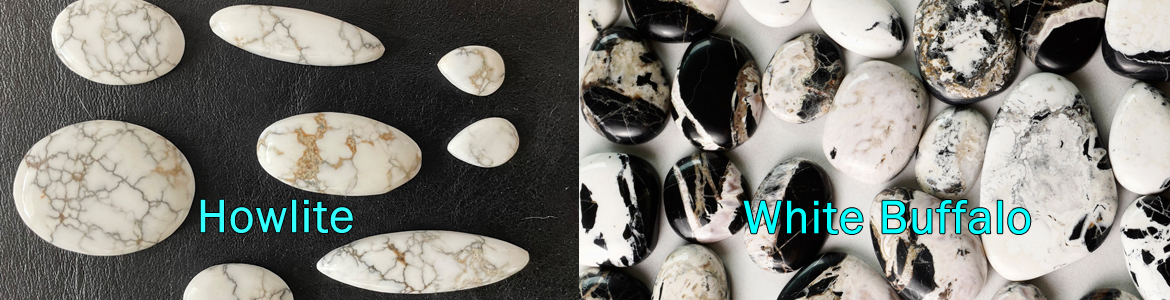
But here’s where things get confusing: appearance alone doesn’t always tell you what a stone is.
A white stone with dark veining could be Howlite, Magnesite, or another material entirely. That’s why I believe it’s important to know as much as possible about where a stone came from and how it was identified.
For jewelry buyers, the important thing is understanding what they’re purchasing rather than relying solely on a popular gemstone name.
What Is White Turquoise?
The term White Turquoise adds another layer of confusion.
Genuine turquoise can occur in very pale shades of blue or green, sometimes appearing almost white. However, much of the material sold commercially as White Turquoise is actually another type of stone.
Howlite and Magnesite are two materials that have sometimes been marketed under this name.
Just because a stone is white and has attractive dark veining doesn’t mean it’s genuine turquoise.
When purchasing jewelry, it’s always worth asking whether the stone is natural, dyed, stabilized, or otherwise treated, and whether its identification has been verified.
What About Magnesite and Wild Horse Stone?
 Magnesite is another naturally occurring mineral that can resemble both Howlite and White Buffalo. It is often white or cream-colored and may contain dark veining.
Wild Horse stone, sometimes called Crazy Horse or Appaloosa stone, is another decorative material that can create confusion.
Wild Horse typically features a creamy white background with brown or reddish-brown patterns, giving it an appearance reminiscent of a spotted horse.
Like White Buffalo, Wild Horse is a commercial stone name rather than a distinct mineral species.
Although these stones may share similar appearances, they each have their own characteristics and appeal.
From Rough Stone to Handmade Jewelry
Whether I’m working with White Buffalo, Howlite, turquoise, or variscite, one of my greatest pleasures is discovering the beauty hidden inside rough stone.
Some of the material I use comes from my own rockhounding adventures in Nevada, while other stones are acquired from fellow collectors and trusted dealers.
Each piece is individually cut, shaped, and polished to bring out its natural patterns and character.
My White Buffalo jewelry features material I’ve personally collected in Nevada’s Candelaria Hills, while my White Horse collection showcases the beautiful natural Howlite that originally inspired its name.
Although these stones are sometimes confused with one another, I appreciate each for its own unique beauty.
After all, it’s those individual patterns and imperfections that make every stone—and every finished piece of jewelry—one of a kind.
Explore White Buffalo and Howlite Jewelry
At Water Dancer Designs, I create handmade, one-of-a-kind jewelry featuring natural stones set in sterling silver.
Whether you prefer the dramatic contrast of White Buffalo or the softer veining of Howlite, both offer beautiful possibilities for distinctive jewelry.
Explore my White Buffalo and White Horse jewelry collections to discover the individual character of these remarkable stones.
Additional Reading
For those interested in learning more about the history and identification of these stones:
- Rock & Gem Magazine: White Buffalo Stone — Russ Kaniuth’s article about White Buffalo, Midnight Buffalo, and the Otteson family.
- Geology.com: Nevada Gemstones — Includes information about mineral testing of White Buffalo material.
- Turquoise in America: Turquoise in America — Historical and educational information about American turquoise.